Europe E-Bike Market Size and Analysis Report

Global Europe E-Bike Market Growth, Size, Trends Analysis- By Class, By Battery, By Motor, By Propulsion, By Ownership, By Power Output, By Sales Channel, By Application – Regional Outlook, Competitive Strategies and Segment Forecast to 2034

Published: Jan-2026 Report ID: AMIN2605 Pages: 1 - 129 Formats*:     
Category : Automotive & Transportation
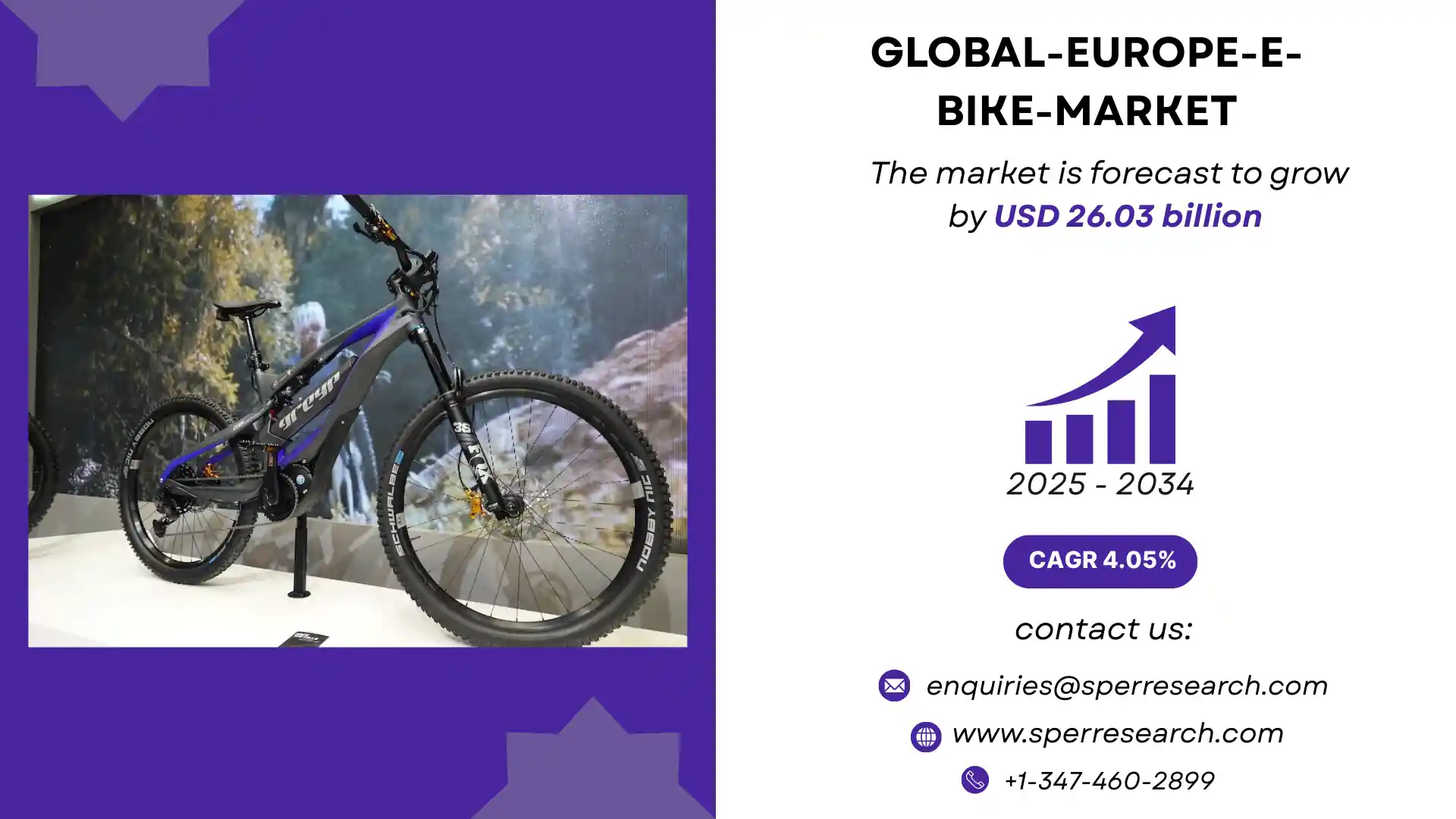
According to SPER Market Research, the Global Europe E-bike Market is estimated to reach USD 26.03 billion by 2034 with a CAGR 4.05%.

Introduction and Overview

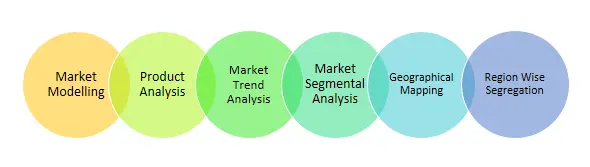
The report includes an in-depth analysis of the Global Europe E-bike Market, including market size and trends, product mix, Applications, and supplier analysis.

Europe E-Bike Market was valued at USD 17.2 billion in 2024 and is expected to grow at a CAGR of around 4.05% between 2025 and 2034. The market is experiencing steady growth as increasing environmental awareness and strong government incentives promote sustainable mobility across cities. Supportive policies and expanding cycling infrastructure are encouraging commuters to shift toward e-bikes for daily travel, last-mile delivery, and recreational riding. Advancements in battery efficiency, smart connectivity, and e-bike technology improve performance and user experience. Rising urban congestion and demand for low-emission transport options are further accelerating adoption, making e-bikes a key component of Europe’s clean mobility ecosystem.

By Class:
By class, Class 1 e-bikes account for the largest share in the Europe e-bike market. These models provide pedal assistance without throttle control and comply fully with European speed and safety regulations. Their legal acceptance on public roads and cycling lanes makes them highly suitable for daily commuting, leisure riding, and urban mobility. Consumers prefer Class 1 e-bikes for their controlled power delivery, safety, and energy efficiency. Class 2 e-bikes face regulatory restrictions in several countries due to throttle operation, while Class 3 e-bikes are limited by speed regulations and usage constraints, reducing their overall adoption across Europe.

By Battery:
Lithium-ion batteries hold the leading share in the Europe e-bike market due to their superior performance characteristics. These batteries offer high energy density, lighter weight, faster charging, and longer lifespan, which enhance riding range and efficiency. Their compatibility with modern e-bike designs and smart systems further supports widespread adoption. European consumers prioritize reliability and sustainability, making lithium-ion batteries the preferred choice. Lead-acid batteries are still used in limited low-cost models but are losing relevance due to heavier weight and shorter life cycles. Other battery types remain niche, primarily restricted to experimental or specialized applications.

By Motor:
Mid motors represent the largest share in the Europe e-bike market, driven by their superior riding dynamics and efficiency. Positioned at the bike’s center, mid motors provide better weight distribution, enhanced balance, and improved torque performance, especially on inclines and uneven terrain. These features make them ideal for urban commuting, trekking, and cargo applications. European consumers value comfort, control, and performance, which supports strong preference for mid motors. Hub motors are mainly used in entry-level and city models due to lower cost, but they offer comparatively less efficiency and riding stability than mid-motor systems.

By Propulsion:
Pedal-assist propulsion accounts for the highest adoption across the Europe e-bike market. This system activates motor support only when the rider pedals, improving energy efficiency and ensuring safer speed control. Pedal-assist e-bikes align well with European transport regulations and are widely accepted for use on bike lanes and urban roads. They support both fitness and mobility needs, making them popular among commuters, older riders, and leisure users. Throttle-controlled e-bikes face regulatory limitations in many European countries, which restricts their usage and limits broader adoption compared to pedal-assist systems.

By Ownership:
Personal ownership represents the largest share in the Europe e-bike market, supported by strong cycling culture and increasing use of e-bikes for daily commuting. Consumers prefer owning e-bikes for convenience, flexibility, and long-term cost savings. Personal e-bikes are widely used for work travel, fitness, and recreational purposes. Government incentives and expanding cycling infrastructure further encourage individual ownership. Shared e-bike services are growing in major cities and tourist destinations; however, operational costs, infrastructure limitations, and fleet maintenance challenges currently restrict shared models from matching the scale of personal ownership across the region.

By Power Output:
E-bikes with below 250W power output account for the largest share in Europe, as this category aligns with European Union regulations governing electric bicycles. These models are legally permitted on public roads and cycling paths without licensing or registration requirements. Power output below 250W provides sufficient assistance for urban commuting while ensuring safety and energy efficiency. E-bikes in the 250W to 750W range are used in specialized applications such as cargo transport but face regulatory constraints. Models above 750W are highly restricted, limiting their adoption to niche or off-road use cases.

By Sales Channel:
Offline sales channels account for the largest share in the Europe e-bike market, as consumers prefer purchasing from physical stores. Bicycle retailers and specialty stores allow customers to test ride, compare models, and receive professional guidance. Offline channels also provide installation, servicing, and warranty support, which enhances buyer confidence. Financing options and customization services further strengthen offline sales. Online channels are expanding due to convenience and wider product visibility, but concerns related to assembly, after-sales service, and maintenance continue to limit online sales from surpassing traditional retail formats across Europe.

By Application:
City and urban applications account for the largest share of the Europe e-bike market, with Class 1 e-bikes being most widely used due to regulatory compliance and commuting suitability. Trekking applications also see strong adoption of Class 1 models for long-distance comfort and efficiency. In cargo applications, Class 1 e-bikes are preferred for last-mile delivery and logistics within cities. Mountain and off-road usage remain niche, mainly restricted to regulated trails. Other applications, including leisure and tourism, continue to rely primarily on Class 1 e-bikes for safe and versatile riding experiences.

Regional Insights:
The Europe e-bike market shows varied adoption patterns across regions, shaped by infrastructure, policy support, and consumer preferences. Western Europe, led by Germany, France, the Netherlands, and Switzerland, represents a mature landscape with strong cycling culture, advanced infrastructure, and widespread use of e-bikes for commuting and leisure. Northern Europe, including the UK, Denmark, Sweden, Finland, and Norway, benefits from sustainability-focused policies and high environmental awareness, supporting steady adoption. Southern Europe, led by Italy and Spain, is witnessing rising demand driven by urban congestion and tourism. Eastern Europe is emerging gradually, supported by improving infrastructure and growing affordability awareness.

Market Competitive Landscape:
The Europe E-bike Market is highly consolidated. Some of the market key players are Pon, Giant Bicycles, Accell, Trek Bicycle, Yamaha, Baltik Vairas, Rad Power Bikes, Brompton, Riese & Müller, CUBE

Recent Developments:
  • In February 2024, Cowboy launched an at- home mobile service for its European guests, furnishing on- demand services including bike setup, conservation, flat tire form, hinder racks and child seat installation, etc. services starting from USD 74, and reserved via the mobile app that enhances post-purchase client support.
  • In January 2024, Vanpowers launched two new electric bike models, the Grand Teton, an all- terrain mountain electric bike and Urban Cross, a featherlight clay electric bike. Each model includes Vanpowers' innovative smart security system, demonstrating their commitment to ingeniousness and rider safety.
  • In November 2023, Up way blazoned it raised EUR 27.6 million in a Series B investment round led by Korelya Capital, putting their total backing to EUR 55.2 million. The investment will help Up way grow and expand into all of Europe and beyond as it continues to grow as a leading e-bike business.
  • In November 2023, Ultraviolette Automotive verified plans to send their F77 electric motorcycle in the European request. The company expects to commence delivery in Europe in Q2 2024 and will be expanding out to other transnational requests as well.
  • In June 2023, Vanpowers blazoned the Urban Glide launched in Europe and is a high- performance commuter electric bike, with the Urban Glide having a 500- watt mecca motor with a 110- kilometer range per charge. The Urban Glide was available for preorder starting at EUR 2,599 and was acclimatized for the civic commuter rider.

Scope of the report:
Report MetricDetails
Market size available for years2021-2034
Base year considered2024
Forecast period2025-2034
Segments coveredBy Class, By Battery, By Motor, By Propulsion, By Ownership, By Power Output, By Sales Channel, By Application
Regions coveredNorth America, Latin America, Asia-Pacific, Europe, and Middle East & Africa
Companies CoveredPon, Giant Bicycles, Accell, Trek Bicycle, Yamaha, Baltik Vairas, Rad Power Bikes, Brompton, Riese & Müller, CUBE


 Key Topics Covered in the Report
  • Global Europe E-bike Market Size (FY’2021-FY’2034)
  • Overview of Global Europe E-bike Market
  • Segmentation of Global Europe E-bike Market by Class (Class 1, Class 2, Class 3)
  • Segmentation of Global Europe E-bike Market by Battery (Lithium-ion, Lead acid, Others)
  • Segmentation of Global Europe E-bike Market by Motor (Hub motor, Mid motor)
  • Segmentation of Global Europe E-bike Market by Propulsion (Pedal assist, Throttle control)
  • Segmentation of Global Europe E-bike Market by Ownership (Shared, Personal)
  • Segmentation of Global Europe E-bike Market by Power Output (Below 250W, 250W to 750W, Above 750W)
  • Segmentation of Global Europe E-bike Market by Sales Channel (Online, Offline)
  • Segmentation of Global Europe E-bike Market by Application (City/urban, Trekking, Cargo, Mountain/off-road, Others)
  • Statistical Snap of Global Europe E-bike Market
  • Expansion Analysis of Global Europe E-bike Market
  • Problems and Obstacles in Global Europe E-bike Market
  • Competitive Landscape in the Global Europe E-bike Market
  • Details on Current Investment in Global Europe E-bike Market
  • Competitive Analysis of Global Europe E-bike Market
  • Prominent Players in the Global Europe E-bike Market
  • SWOT Analysis of Global Europe E-bike Market
  • Global Europe E-bike Market Future Outlook and Projections (FY’2025-FY’2034)
  • Recommendations from Analyst

1.Introduction
1.1. Scope of the report
1.2. Market segment analysis 

2.Research Methodology
2.1. Research data source
2.1.1. Secondary Data
2.1.2. Primary Data
2.1.3. SPER’s internal database
2.1.4. Premium insight from KOL’s
2.2. Market size estimation
2.2.1. Top-down and Bottom-up approach
2.3. Data triangulation

3.Executive Summary

4. Market Dynamics
4.1. Driver, Restraint, Opportunity and Challenges analysis
4.1.1. Drivers
4.1.2. Restraints
4.1.3. Opportunities
4.1.4. Challenges

5.Market variable and outlook
5.1. SWOT Analysis
5.1.1. Strengths
5.1.2. Weaknesses
5.1.3. Opportunities
5.1.4. Threats
5.2. PESTEL Analysis
5.2.1. Political Landscape
5.2.2. Economic Landscape
5.2.3. Social Landscape
5.2.4. Technological Landscape
5.2.5. Environmental Landscape
5.2.6. Legal Landscape
5.3. PORTER’s Five Forces 
5.3.1. Bargaining power of suppliers
5.3.2. Bargaining power of buyers
5.3.3. Threat of Substitute
5.3.4. Threat of new entrant
5.3.5. Competitive rivalry
5.4. Heat Map Analysis

6.Competitive Landscape
6.1. Global Europe E-bike Market Manufacturing Base Distribution, Sales Area, Product Type 
6.2. Mergers & Acquisitions, Partnerships, Product Launch, and Collaboration in Global Europe E-bike Market

7.Global Europe E-bike Market, By Class, (USD Million) 2021-2034 
7.1. Class 1
7.2. Class 2
7.3. Class 3

8.Global Europe E-bike Market, By Battery, (USD Million) 2021-2034 
8.1. Lithium-ion
8.2. Lead acid
8.3. Others

9.Global Europe E-bike Market, By Motor, (USD Million) 2021-2034  
9.1. Hub motor
9.2. Mid motor

10.Global Europe E-bike Market, By Propulsion, (USD Million) 2021-2034  
10.1.Pedal assist
10.2.Throttle control

11.Global Europe E-bike Market, By Ownership, (USD Million) 2021-2034 
11.1.Shared
11.2.Personal

12.Global Europe E-bike Market, By Power output, (USD Million) 2021-2034
12.1.  Below 250W
12.2. 250W to 750W
12.3. Above 750W

13.Global Europe E-bike Market, By Sales Channel, (USD Million) 2021-2034 
13.1. Online
13.2. Offline

14.Global Europe E-bike Market, By Application, (USD Million) 2021-2034 
14.1. City/urban
14.1.1. Class 1
14.1.2. Class 2
14.1.3. Class 3
14.2. Trekking
14.2.1. Class 1
14.2.2. Class 2
14.2.3. Class 3
14.3. Cargo
14.3.1. Class 1
14.3.2. Class 2
14.3.3. Class 3
14.4. Mountain/off-road
14.4.1. Class 1
14.4.2. Class 2
14.4.3. Class 3
14.5. Others
14.5.1. Class 1
14.5.2. Class 2
14.5.3. Class 3

15.Global Europe E-bike Market, (USD Million) 2021-2034 
15.1. Global Europe E-bike Market Size and Market Share

16.Global Europe E-bike Market, By Region, 2021-2034 (USD Million)
16.1. Asia-Pacific
16.1.1. Australia
16.1.2. China
16.1.3. India
16.1.4. Japan
16.1.5. South Korea
16.1.6. Rest of Asia-Pacific
16.2. Europe
16.2.1. France
16.2.2. Germany
16.2.3. Italy
16.2.4. Spain
16.2.5. United Kingdom
16.2.6. Rest of Europe
16.3. Middle East and Africa
16.3.1. Kingdom of Saudi Arabia 
16.3.2. United Arab Emirates
16.3.3. Qatar
16.3.4. South Africa
16.3.5. Egypt
16.3.6. Morocco
16.3.7. Nigeria
16.3.8. Rest of Middle-East and Africa
16.4. North America
16.4.1. Canada
16.4.2. Mexico
16.4.3. United States
16.5. Latin America
16.5.1. Argentina
16.5.2. Brazil
16.5.3. Rest of Latin America 

17.Company Profile
17.1. Pon
17.1.1. Company details
17.1.2. Financial outlook
17.1.3. Product summary 
17.1.4. Recent developments
17.2. Giant Bicycle
17.2.1. Company details
17.2.2. Financial outlook
17.2.3. Product summary 
17.2.4. Recent developments
17.3. Accell
17.3.1. Company details
17.3.2. Financial outlook
17.3.3. Product summary 
17.3.4. Recent developments
17.4. Trek Bicycle
17.4.1. Company details
17.4.2. Financial outlook
17.4.3. Product summary 
17.4.4. Recent developments
17.5. Yamaha
17.5.1. Company details
17.5.2. Financial outlook
17.5.3. Product summary 
17.5.4. Recent developments
17.6. Baltik Vairas
17.6.1. Company details
17.6.2. Financial outlook
17.6.3. Product summary 
17.6.4. Recent developments
17.7. Rad Power Bikes
17.7.1. Company details
17.7.2. Financial outlook
17.7.3. Product summary 
17.7.4. Recent developments
17.8. Brompton
17.8.1. Company details
17.8.2. Financial outlook
17.8.3. Product summary 
17.8.4. Recent developments
17.9. Riese & Müller
17.9.1. Company details
17.9.2. Financial outlook
17.9.3. Product summary 
17.9.4. Recent developments
17.10. CUBE
17.10.1. Company details
17.10.2. Financial outlook
17.10.3. Product summary 
17.10.4. Recent developments

18. Conclusion

19. List of Abbreviations

20. Reference Links

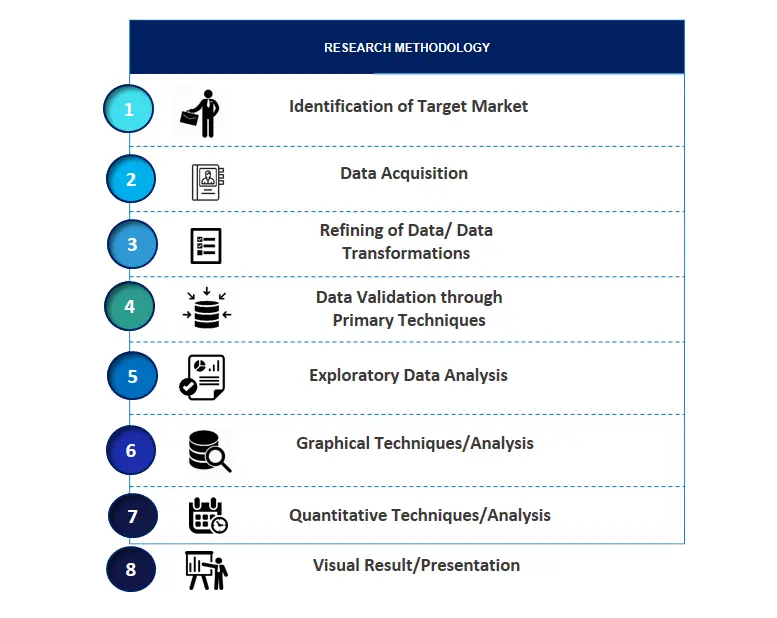
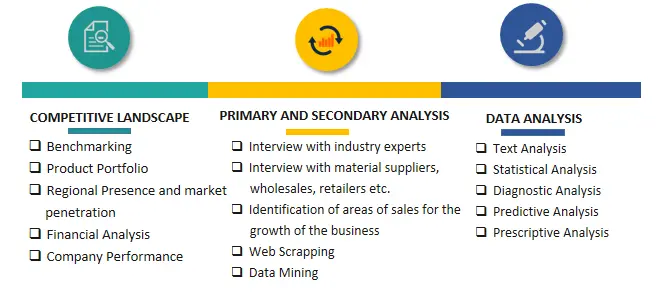
SPER Market Research’s methodology uses great emphasis on primary research to ensure that the market intelligence insights are up to date, reliable and accurate. Primary interviews are done with players involved in each phase of a supply chain to analyze the market forecasting. The secondary research method is used to help you fully understand how the future markets and the spending patterns look likes.

The report is based on in-depth qualitative and quantitative analysis of the Product Market. The quantitative analysis involves the application of various projection and sampling techniques. The qualitative analysis involves primary interviews, surveys, and vendor briefings.  The data gathered as a result of these processes are validated through experts opinion. Our research methodology entails an ideal mixture of primary and secondary initiatives.
SPER-Methodology-1

SPER-Methodology-2

SPER-Methodology-3


Frequently Asked Questions About This Report
The market is expanding due to rising environmental awareness, strong government incentives, and supportive cycling infrastructure. These factors encourage commuters to adopt e-bikes for daily travel, last-mile delivery, and recreational purposes, making them a key part of Europe’s clean mobility ecosystem.
Advancements in battery efficiency, smart connectivity, and e-bike technology are enhancing performance, safety, and user convenience. Features such as longer battery life, integrated navigation, and smart riding apps are making e-bikes more appealing to both urban commuters and leisure riders.
Government policies promoting sustainable mobility, including subsidies, tax incentives, and investments in cycling infrastructure, are accelerating e-bike adoption. These initiatives reduce costs for consumers and support the transition toward low-emission transport solutions in congested urban areas.
PLACE AN ORDER
  • 15 % off
     
    $ 4250
  • 20 % off
             
    $ 5650
  • 25 % off
         
    $ 7450
Pre-Purchase Inquiry
SEND AN INQUIRY
NEED CUSTOMIZATION?
Request Customization
CALL OR EMAIL US
US:
India:
Email:
100% Secure Payment

SPER American Express
SPER VISA
SPER Master Card
SPER Mestro
SPER Paypal
SPER CCAvenues

Have a glance of the Report

  Download Free Sample

Looking for Customization?

 Customization Request

Have a Question?

 Reach Our Analysis Team

COVID-19 impact analysis?

 Request Analysis
Thought Leadership

Trusted by Industry Leaders

Our data-driven insights have influenced the strategy of 200+ reputed companies across the globe.

SPER-Astellas Pharma
SPER-Microsoft
SPER-EY
SPER-McKinsey
SPER-Bain
SPER-Max-Healthcare
SPER-DHL
SPER-IQVIA
SPER-Mitsubishi Logistics
SPER-PACCOR
SPER-Macmillan Education
SPER-Kankar IMRB
SPER-ITA
SPER-PWC
SPER-SAPTCA
SPER-Straumann
SPER-Danaher
SPER-AandM
SPER-MENARINI Silicon Biosystems
SPER-IPSOS
SPER-Heineken
HIPPA Compliant
GDPR Certified
ISO 27001
Peer Reviewed
Get Started Today

Your Competitive Advantage in
Pharmaceutical & Medical Technology
Markets

Join industry leaders leveraging AI-powered intelligence to make confident, data-driven decisions that accelerate breakthrough treatments and technologies to market.

No Credit Card Required
15-Minute Demo
Expert Guidance